

Dallas, Texas, 1954. Bette Nesmith Graham was drowning.
She was a divorced single mother raising her young son Michael on a secretary's salary of $300 a month. She'd dropped out of high school, and her typing skills were honestly terrible. But she needed this job at Texas Bank & Trust desperately—she was the sole provider for her family.
The problem? Her boss demanded perfection from an imperfect typist using newly-installed IBM electric typewriters that made mistakes nearly impossible to correct.
One error meant retyping an entire page. Sometimes multiple pages. Hours of work erased by a single slip of the finger. The new carbon-film ribbons made pencil erasers useless—they just smudged the page into an even worse mess.
Bette was drowning in her own mistakes, terrified every day that she'd lose the job her family depended on.
Then one December day in 1954, she watched artists painting holiday decorations on the bank's windows. She noticed something that changed everything: when they made a mistake, they didn't start over. They simply painted over the error and continued.
Why couldn't she do the same with typing?
That night in her kitchen, Bette mixed water-based tempera paint in her blender, carefully tinting it to match the bank's stationery. She poured it into a small bottle, grabbed a watercolor brush, and brought it to work the next day.
The first time she painted over a typo, her heart pounded. Would it show? Would her boss notice?
It dried perfectly. Her boss never noticed the correction.
Bette had just invented something that would change the world—she just didn't know it yet.
Other secretaries noticed. They started asking for bottles of her "magic paint." She began mixing batches in her kitchen after work, calling it "Mistake Out," filling bottles by hand with help from her teenage son Michael and his friends, paying them $1 an hour.
What started as survival became something bigger.
By 1957, she was selling about 100 bottles per month out of her house. In 1958, she renamed the product "Liquid Paper" and began applying for patents. Orders flooded in after an office supply magazine featured it—500 inquiries from a single article. General Electric placed a massive order for over 400 bottles in three colors.
But juggling her day job with a rapidly growing business was becoming impossible. She'd work all day as a secretary, then stay up all night filling orders, answering letters, perfecting her formula.
Then came the mistake that changed everything.
In 1958, exhausted from working two full-time jobs, Bette accidentally signed a bank letter with "The Mistake Out Company" instead of her employer's name.
She was fired on the spot.
Many would have seen it as devastating failure. Bette saw it as freedom.
With no job holding her back, she threw herself into Liquid Paper full-time. She formalized her business, improved her formula, secured major clients. In 1962, she married salesman Robert Graham, who joined her in building the company.
The growth was extraordinary. By 1968, Liquid Paper had its own automated production facility in Dallas. By 1975, the company was producing 25 million bottles per year and selling in 31 countries worldwide.
But success brought new battles. Her husband tried to wrest control of the company away from her, attempting to change her formula and strip her of royalty rights. She fought back, maintained her 49% stake, and filed for divorce in 1975.
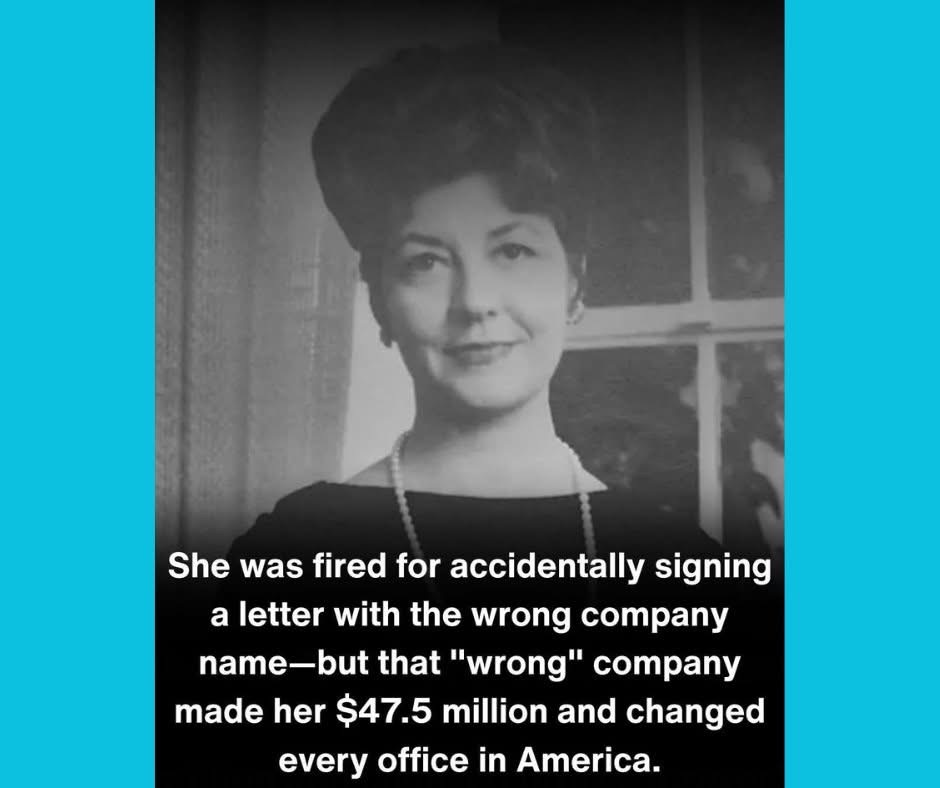
In 1979, Bette Nesmith Graham—high school dropout, fired secretary, single mother who'd once cried over money worries—sold Liquid Paper to the Gillette Corporation for $47.5 million.
She didn't just take the money and disappear. She used her fortune to establish two foundations supporting women in business and the arts. She designed her company with radical ideas for the 1970s: on-site childcare, employee libraries, participatory decision-making. She believed business could be built on dignity, not just profit.
Bette died in 1980, just six months after the sale, at age 56 from complications of a stroke. Her son Michael—who'd once filled Liquid Paper bottles for $1 an hour in her kitchen—inherited half her estate: over $25 million.
You might know Michael better as Mike Nesmith of The Monkees. He continued his mother's philanthropic work, later telling David Letterman: "She had a vision... she built it into a big multimillion-dollar international corporation and saved the lives of a lot of secretaries."
The irony is perfect: A woman fired for making a mistake built an empire by helping millions of others fix theirs.
Before Liquid Paper, a single typo could mean hours of lost work and the constant fear of being fired for imperfection. After Liquid Paper, mistakes became fixable in seconds. Bette Nesmith Graham didn't just invent correction fluid—she gave people permission to be imperfect and still succeed.
Her story isn't really about white paint in a bottle. It's about what happens when someone refuses to accept that there's no solution. It's about turning your biggest weakness into your greatest strength. It's about looking at a problem everyone accepted as unsolvable and thinking, "There has to be a better way."
And there was. She just had to invent it herself.
The mistake that got her fired became the fortune that set her free.
Sometimes the best correction isn't on the page—it's the one you make to your own life.
The Past few days I’ve been thinking about the anniversary of the loss of my dad back in 2015. It was a pure blessing to take care of him and his final living years. I wanted to show you some of my trees. I’m growing. We have a peach tree, a mango tree, a low quad tree and an avocado tree. And the flower box I’m growing my grape vines which are in their infancy and they’re finishing up their season.
Good morning 😃 the pool is 79 now and it should be 80 in a couple hours so I will be going swimming today. This is probably going to be my last week of swimming because I believe we’re gonna be heading into fall temperatures which bring my pool temperature down. I definitely want to get a pool heater.
I will have less of a presence on The Torrid Tribe Community. We have very little activity here. This is a sign to me that members have found other social media resources that they are spending more time in. I am happy to see less censorship on social media in general. I started The Torrid Tribe 4 years ago when we were in a state of censorship and lockdowns. It was a difficult time and this was a haven and sanctuary for so many.
I will be lightly posting things here to give you all content to see. This community will always be open to everyone and will resurrect to its full capacity if subscribers show they want it fully operational again with full time administration.
Thank you for being a part of this community. Sending each of you hugs.
K-
Creator of The Torrid Tribe

Passion is the vibe that I want to bring to this community. I want to enjoy your passion for whatever it is you are into. Let's share what we learn - and learn what each other shares. Foodies unite. I love to cook and share recipes. I will regularly post pictures and recipes are available upon request. I would enjoy discussing your past, present and future journeys. Nature is God and Mother Earth's exquisite gift to us. Share a picture and we will enjoy the beauty through your eyes. Let's get deep and consensual with great subjective matter. This is a non judgemental safe place to let everything hang out.
Thank you for your membership contribution subscription. It sponsors our frequent zooms.
For those members that are enjoying this Community, Please consider subscribing. Your commitment will help this Community thrive.
Thank you and hugs.
Torri